
To life’s thread: Embodiment, infrastructure, and remembrance
Nava Messas-Waxman | Shannon Garden-Smith | Angel Callander
York University
To Life's Thread is a collaborative intermedial research-project combining performance, slow hand-work of dyeing wool, drawing, and thread making.
Through collective experimentation, performative gesture, and iterative practice with materials and space, To Life's Thread explores the rituals associated with both henna and achiote, tracing the reciprocal relations between them while contemplating the potential of recuperation, multicodedness, and decolonizing performance methods as a radical space for cultural transmission, a mediating form of memory, and as an enduring practice of cultural sustainability.
This research-creation project's use of translations as alternative modes and multicodedness allows us to bypass the colonial gaze while carrying the potential for collective agency embedded in these practices.
In The Archive and the Repertoire: Performing Cultural Memory in the Americas, the performance scholar Diana Taylor writes about the vital role of our repertoire in the transmission of cultural memory and embodied knowledge across generations. These repertoires enact our embodied memory and cultural knowledge through ephemeral practices—performances, gestures, rituals, movement, dance, singing—which constitute non-reproducible knowledge (Taylor 2003). Taylor contrasts two epistemic systems: the repertoire—ephemeral, embodied, living—and the archive—documented, objectified, and potentially repeatable across time. The two are not mutually exclusive but reversible and deeply entangled. Taylor describes embodied performance practice as "multicoded" to acknowledge Indigenous rituals adopted and adapted after Conquest as a means to preserve, with variations, pre-Conquest customs and rituals.
Another form of performative gesture that has been explored draws on the notion of recuperation as a decolonial performance tactic that facilitates communal healing (Oviedo 2022). It involves imagining and performing something that occurred in the past, utilizing creative freedom to change how it is perceived, felt, or remembered. Multicodedness is used to describe cultural practices, performances, rituals, and ceremonies that move through multiple registers, politically and aesthetically, and where cultural meanings are transmitted through the convergence of spectators and participants in performative acts. Rituals, inscriptions, marking, thread making, untangling, and knotting become multidimensional, relational forms of expression, transcending individual marking and moving toward co-becoming and presence within a continuum of relations.
The title to Life's thread is borrowed from Cecilia Vicuña's poem A Ritual response, whose lines became a choreographic proposition that guided this work. This collaborative work is open-ended, with our ideas and threads producing various materials. As an evolving project, these materials remain open to different modulations within our future installation.
Read “To life’s thread: Embodiment, infrastructure, and remembrance” by Angel Callander
"What emerges from a materialist, historically conscious worldview is a certain perspective on the ways in which Western progress narratives tend to pave over various other systems of knowledge and societal organization—often literally—in favour of individualism and its discontents. Across several visits with artists, farmers, and Indigenous community members in Costa Rica, topics of infrastructure, systems, and subsistence architectures continuously surfaced as cornerstones of discussion, undergirding much of our observations. Artist and activist Raquel Bolaños highlighted how she has been able to connect art-making with a larger resistance project against corporate dam-building to harness Costa Rica’s fresh water supply for energy production. Cocoa farmer Marvin spoke similarly about his work as a way of resisting the domineering structures of corporate farming, teaching others in a growing longevity effort. Visiting the Brunca community and witnessing their economic subsistence through textile production and mask-making, as well as the performance of the Cájc Chí theatre group, provided an example of transmitting cultural memory to survive amidst a long-established colonial structure that has tried to prevent this. In essence, these three experiences resonate with broader discourses on resisting capitalist powers and their ingrained infrastructures, as well as the many strategies there are for doing so."

Reading Cecilia, Spindle spinning
The title to Life's thread is borrowed from Cecilia Vicuña's poem A Ritual response, whose threads became a choreographic proposition that guided this creative process and work.

Reading Cecilia. Photograph by Shannon
Dyeing wool with henna and achiote. Slow hand-work, preparing wool for spinning into yarn.


A gathering
reading Cecilia, ritual spinning
Stills from video performance


Untangling
Stills from video performance 16:43 minutes


Knowing Water, Liquid Ecologies: In Dialogue with Taddle Creek
If the memory of an event is a "trace" in the land, the actions that took place long ago are "etched" there, but "long ago" may become tomorrow at anytime! -Cecilia Vicuña
Reading Cecilia Vicuña

Collaborative experimental mark-making drawing performance using sand, blue indigo mineral, Clay and sand
Link to view the VIDEO documentation.


Site-specific performance intervention
tracing Taddle Creek along the Philosopher's Walk, Toronto, June 2025
Performance remain

Inscriptions of tomorrow
Reconstructing experimental performance video of untangling threads that we have received from the Boruca women during a workshop at Las Nubes EcoCampus.
A haptic interpretation projected onto a Saharan skin drum.

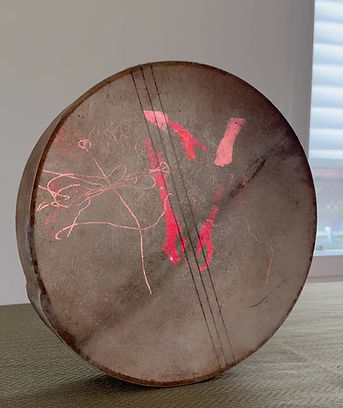
An archive of longing?
Small Infinitudes?
-Marta Werner


poetic mapping


